
Safeguarding Policy and Procedure
Overview
The Pod believes it is always unacceptable for a child or vulnerable adult to experience abuse of any kind and recognises its responsibility to safeguard the welfare of all children and vulnerable adults. The charity is committed to creating and maintaining the safest possible environment for children, young people and adults and acknowledges its duty to act appropriately to any allegations, reports or suspicions of abuse.
This policy applies to all staff, trustees, volunteers, sessional workers, agency staff, visitors, students and anyone working on behalf of The Pod.
This policy is to be read in conjunction with:
- Online Safety & Social Media Policy
- The Code of Conduct for Adults Working with Children & Vulnerable Adults
- Staff Recruitment and Vetting Policy
- Risk Assessment Policy and activity risk assessments.
- Volunteer Policy
- Behaviour Policy
- Recording Policy
- Data Protection policy
The purpose of this policy is:
- To promote good practice and work in a way that can prevent harm and abuse occurring;
- To provide protection for the Children and Vulnerable adults who receive services from The Pod, including the children of adult members or users.
- To ensure that any allegations of abuse or suspicions are dealt with appropriately and the person experiencing abuse is supported.
Definitions
Safeguarding children is defined in Working together to safeguard children as:
- protecting children from maltreatment
- preventing impairment of children’s health or development
- ensuring that children are growing up in circumstances consistent with the provision of safe and effective care
- taking action to enable all children to have the best outcomes
- Children refers to anyone aged 17 and under.
Safeguarding vulnerable adults is defined in the Care and support statutory guidance issued under the Care Act 2014 as:
- protecting the rights of adults to live in safety, free from abuse and neglect
- people and organisations working together to prevent and stop both the risks and experience of abuse or neglect
- people and organisations making sure that the adult’s wellbeing is promoted including, where appropriate, taking fully into account their views, wishes, feelings and beliefs in deciding on any action
- recognising that adults sometimes have complex interpersonal relationships and may be ambivalent, unclear or unrealistic about their personal circumstances and therefore potential risks to their safety or well-being
- A vulnerable adult is a person aged 18 or over who is unable to protect themselves from abuse, harm, or exploitation due to illness, disability, or other impairments. This lack of capacity may be temporary or indefinite and can put them at risk of harm, such as neglect, financial abuse, or physical abuse. The definition includes a wide range of individuals, such as the elderly, people with learning disabilities, mental health problems, or long-term health conditions.
Policy statement
The Pod believes that safeguarding is everyone’s responsibility and that we all have a role to play in preventing harm and abuse.
The Pod recognises our responsibility to be aware, open and proactive in the field of safeguarding children and vulnerable adults. This policy has been written to ensure that The Pod takes every reasonable measure to safeguard children and vulnerable adults.
The guiding principles of our safeguarding practice are as follows:
- The welfare of the child/vulnerable adult is always paramount.
- The Pod believes that it is always unacceptable for a child/vulnerable adult to experience abuse of any kind.
- In matters relating to safeguarding, the child/vulnerable adult’s wellbeing and welfare must always come first.
- Working in partnership with children, vulnerable adults, their parents, carers and relevant agencies is essential in promoting the welfare of children and vulnerable adults.
- Children and vulnerable adults will always be listened to and taken seriously.
- We will report any concerns about children and vulnerable adults to the appropriate authorities. Wherever possible, we will seek to do this with the express permission of those involved and their families. However, fears of jeopardising the relationship between The Pod and its community will not be allowed to interfere with safeguarding decisions.
- When taking action relating to safeguarding, The Pod will use trauma informed and relationship-based approaches in line with our ethos.Allegations against staff or volunteers will be taken seriously and dealt with promptly and fairly, in accordance with procedures.
- Staff and volunteers working directly with children or vulnerable adults will receive safeguarding training appropriate to their role and responsibilities. Volunteers supporting only open-access activities will receive an appropriate safeguarding briefing and guidance relevant to their role.
- The Pod will operate safer recruitment and vetting procedures in line with its Staff Vetting Policy and current government guidance. Enhanced DBS checks will be undertaken for all staff and volunteers carrying out roles that are eligible for checks.
- Volunteers supporting only open-access activities, where DBS checks are not required, will be appropriately supervised and clearly identifiable through a distinct badge or lanyard system.
Forms of harm and legislation
All children and vulnerable adults, regardless of age, disability, gender, racial heritage, religious belief, sexual orientation or identity, have the right to equal protection from all types of harm or abuse as defined by Somerset Safeguarding Children’s Board https://somersetsafeguardingchildren.org.uk) and Adult Social Care government guidelines (www.gov.uk )as follows;
- Children – Physical, emotional (or psychological), sexual and neglect.
- Adults – Physical, emotional (or psychological), sexual, neglect, financial, discriminatory, organisational, domestic abuse, modern slavery and self-neglect.
The major pieces of relevant legislation and guidance, including all updates to date are:
- Children Act 1989 & 2004
- Care Act 2014 & Guidance
- Safeguarding Vulnerable Groups Act 2006
- Public Interest Disclosure Act 1998
- Data Protection Act 1998
- European Convention of Human Rights
- Mental Capacity Act 2005
- Disclosure and Barring Service
- Equality Act 2010
- Working Together to Safeguard Children 2015, updated 2023.
- Modern Slavery Act 2015
- Keeping Children Safe in Education 2015
- Domestic Abuse Act 2021.
- Online Safety Act 2023
Roles and responsibilities
The Trustees have overall responsibility for Safeguarding at The Pod. Their responsibilities include:
- To oversee an annual audit and review of safeguarding practice and policy.
- Have a designated trustee named as ‘Safeguarding Trustee’.
- Trustees will be aware of the potential impact of managing safeguarding concerns and understands, this may place staff at risk of emotional strain caused by hearing about others’ traumatic experiences, as well as burnout – trustees will take proactive action to support staff in managing this.
- Appoint at least two Designated Safeguarding Leads (DSLs) who will take specific responsibility for the protection of children and vulnerable adults and act as the main point of contact for parents, children, adults and outside agencies. DSLs will be DBS checked and will attend refresher Working Together Training at least once every two years.
The Safeguarding Trustee’s role is to:
- Work with the DSLs to oversee the safeguarding audit and report on this annually to the Trustee Board.
- Provide professional advice and support to the DSLs.
- Ensure that The Pod’s policies and procedures reflect best practice and current legislation relating to safeguarding.
- Be a point of contact for The Pod staff in the absence of the DSL or should they feel unable to speak with the DSLs.
- Champion safeguarding across the Board of Trustees and ensure all Trustees complete face to face safeguarding training at least once every two years.
The Leadership team and DSLs will:
- Ensure The Pod operates safer recruitment and vetting procedures in accordance with its Staff Vetting Policy. Enhanced DBS checks will be obtained for staff and volunteers undertaking eligible regulated activity or roles involving unsupervised work with children or adults at risk.
- Ensure that where volunteers support only open-access or community activities and are not eligible for DBS checking, they are appropriately supervised and clearly identifiable through a distinct badge or lanyard system.
- Ensure that if a candidate or DBS check discloses an unspent conviction, a suitability assessment form is completed and processed before a decision is made (see appendix A)
- Provide effective management for all colleagues working directly and indirectly with children and vulnerable adults, through supervision, support and annual safeguarding training – This must include face to face training at least once every 2 years.
- Ensure that risk assessments are carried out for each project, event, or venue to ensure the safety of attendees, staff and volunteers.
- Ensure this policy is communicated effectively to all staff, volunteers and visitors, ensuring that all visitors to The Pod read and sign a visitor agreement prior to working with children and vulnerable adults in our care.
- Work with the Safeguarding Trustee to ensure that safeguarding practice and policy is reviewed annually.
It is everyone’s responsibility to:
- Treat all children and vulnerable adults with whom they come into contact while carrying out their work equally, listening to and respecting them.
- Ensure they are familiar with and follow all The Pod policies and procedures relating to their work with children and vulnerable adults.
- Share information about concerns with their Line Manager and agencies who need to know, involve parents and children when it is appropriate to do so.
- Ensure they deal with any incidents of abuse or suspected abuse of children and vulnerable adults in accordance with this policy and procedure.
- Seek additional support from the leadership team if they feel they require further advice or training regarding the protection of children and vulnerable adults.
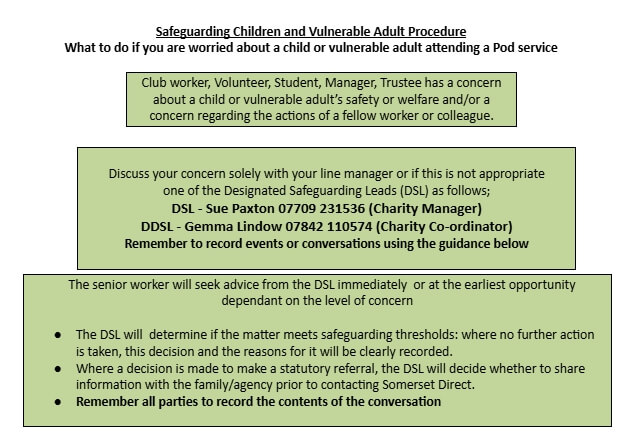

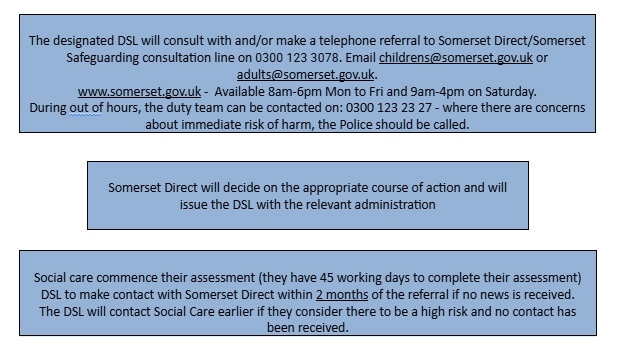
Procedure and Implementation of this policy
Overview
In order to ensure that this policy is fully implemented, the following actions will be taken:
- All participants will be provided with accessible information on The Pod’s safeguarding policies and procedures and implications this may have.
- When The Pod is aware that a family is engaging with Social Care, consent will be sought to enable The Pod to make contact with the Local Authority, promoting a multi-agency response to safeguarding.
- Where a safeguarding concern is identified, one of the DSLs should be alerted as soon as possible.
- Clear and contemporaneous written notes should be made, detailing: the concern, advice received, decisions taken and the rationale for this.
- All safeguarding correspondence is stored securely and is only accessible to team members on a need-to-know basis. This ensures that relevant staff can contribute to a shared case file, enabling the full context to be considered and informed decisions to be made.
- The Pod holds that safeguarding is everyone’s responsibility and promotes a multi agency response.
- The Pod will be active members of any safeguarding procedures and will seek to facilitate good communication between agencies.
- All staff have a responsibility to fully engage with training and keep themselves updated about changes in legislation and best practice.
- Staff will be alert to risk indicators, taking proactive action to safeguard children and vulnerable adults.
Identifying a concern and making a referral
If any of The Pod Team have concerns about the wellbeing or welfare of a child or vulnerable adult, they should immediately inform one of the DSLs. If there is an immediate risk of serious harm, then emergency services should be contacted to take protective action.
In other cases, if following conversation with a DSL, a safeguarding risk is identified, the following actions should be taken:
- The information must be clearly recorded (see record keeping below).
- If the concern relates to a new or first disclosure, in addition, the first disclosure template should be used (see appendix B).
- Where safe and appropriate, concerns should be discussed with the individual, and/or their parent/carer and next steps should be considered, including the potential of a referral to statutory services.
- If it is determined that the safeguarding concern meets thresholds, then a referral should be made following the procedures outlined here:
ADULTS: https://www.somerset.gov.uk/care-and-support-for-adults/
CHILDREN: https://www.somerset.gov.uk/children-families-and-education/report-a-child-at-risk/
- Telephone advice and guidance can also be sought by contacting 0300 123 3078.
- The referral should be thorough, clearly providing all relevant personal information, the nature of the concerns and potential risks identified.
- The referral should always be discussed with the family involved unless you have reason to believe that this would increase the risk to the child or vulnerable adult, or where seeking consent would lead to an inappropriate delay. Where consent has not been sought, this should be clearly articulated on the referral form.
Safeguarding for someone not known to The Pod
On occasion, The Pod may receive information about a child or vulnerable adult who is not known to our services. The Pod has a duty of care to these individuals and should, if appropriate, try to find out identifying information about the person in question.
The staff member receiving the information should discuss with the DSL(s) whether a referral to statutory services is required on the basis of known information. The fact that the child/vulnerable adult is not known to The Pod should not prevent risk information being shared.
Record keeping
Record keeping is highly important in safeguarding matters and the following guidance is provided.
- Records should be clear, thorough and contemporaneous.
- Records should clearly distinguish between fact, opinion and hypothesis.
- Where possible, verbatim quotes should be used.
Records should include:
- Dates, times and location of events or disclosures.
- Clear information about who was present.
- A factual description of the concerns or what happened.
- Any actions taken as a result of the concerns, including copies of referrals or emails.
- Full information about what was said, including the response of the staff member.
- Names and contact details of any agencies contacted.
- Details of any phone calls had with other agencies, including who was spoken to and the advice they provided.
First Disclosures
It is possible that staff working for The Pod will receive a first disclosure – that is the first time someone speaks of abuse or harm. It is highly important that this information is clearly recorded as first disclosures can be used as evidence in criminal proceedings.
Staff will receive training on handling first disclosures. All first disclosures will be clearly recorded using the first disclosure template (appendix b) which will then be stored in the individual’s file.
Consent and confidentiality
The Pod aspires to be transparent – therefore children and adults who engage with The Pod, should be fully informed at the start of engaging with the service, what information will (or could) be shared and why. Their agreement on this should be sought and clearly recorded.
Where possible, workers should respect the wishes of clients who do not consent to sharing confidential information. However, where there are safeguarding concerns about children or vulnerable adults, the welfare and safety of that individual must be the overriding consideration. The decision to share information, or not, must be clearly recorded on the person’s case notes, together with an explanation of the decision made.
Where a decision is made to share information without the consent of the individual concerned, records should clearly demonstrate that this has been on the basis of risk and in order to safeguard the child or vulnerable adult.
In sharing information, staff should consider the following guidance: “ensure that the information you share is necessary for the purpose for which you are sharing it, is shared only with those people who need to have it, is accurate and up to date, is shared in a timely fashion and is shared securely”. For further information on data sharing, please see the data protection policy.
Concerns about someone in a position of authority
Where concerns are raised about someone in a position of authority, who may pose a risk of harm to children, The Pod will contact the Local Area Designated Officer (LADO). The LADO is responsible for managing allegations against adults who work with children (including volunteers), and works closely with other agencies to achieve this.
LADOs do not conduct investigations, but rather oversee and direct them to ensure a thorough, timely and fair process. The LADO should be contacted within one working day of concerns being raised that a person who works with children has:
- Behaved in a way that has harmed, or may harm a child;
- Possibly committed a criminal offence against or related to a child;
- Behaved towards a child or children in a way that indicates they may pose a risk to children.
The LADO can be contacted through: https://somersetsafeguardingchildren.org.uk/working-with-children/allegations-management/
Managing allegations against staff
All The Pod staff and volunteers are expected to behave professionally and maintain appropriate boundaries, keeping the welfare and wellbeing of children and vulnerable adults at the heart of their practice.
If a worker or volunteer is accused of abuse or inappropriate behaviour, this will always be taken seriously. The Pod will follow its disciplinary policy and procedures, which may include suspending the individual staff member. Suspension in this case will be seen as a neutral act to enable the allegation to be fully investigated.
In line with best practice, any allegations must be reported to the Charity Manager, who will inform the Police and LADO if appropriate. The Charity Manager will additionally inform the Chair of Trustees.
In the event that the complaint concerns the Charity Manager, the incident should be reported to the Chair of Trustees, who will take the lead in reporting to the Police and LADO.
Suicide and self-harm
Where concerns are identified regarding a risk of suicide or self-harm, this should be treated as a safeguarding concern and trigger a similar level of response as to children or vulnerable adults at risk of harm from others. The Pod will therefore respond to these risks with compassion, listening to and validating the individual concerned and providing safety advice. In addition, they will follow the safeguarding procedures outlined above.
Support for staff
The Pod recognises that managing safeguarding concerns can be challenging and may place staff at risk of emotional strain caused by hearing about others’ traumatic experiences, as well as burnout. The Pod is committed to providing staff with regular supervision, opportunities for debriefing after difficult cases, and follow-up check-ins to ensure ongoing support. Staff will also be signposted to wellbeing or mental-health services where needed. Staff will be encouraged to seek support promptly and to prioritise their own wellbeing as an essential part of effective safeguarding practice.